
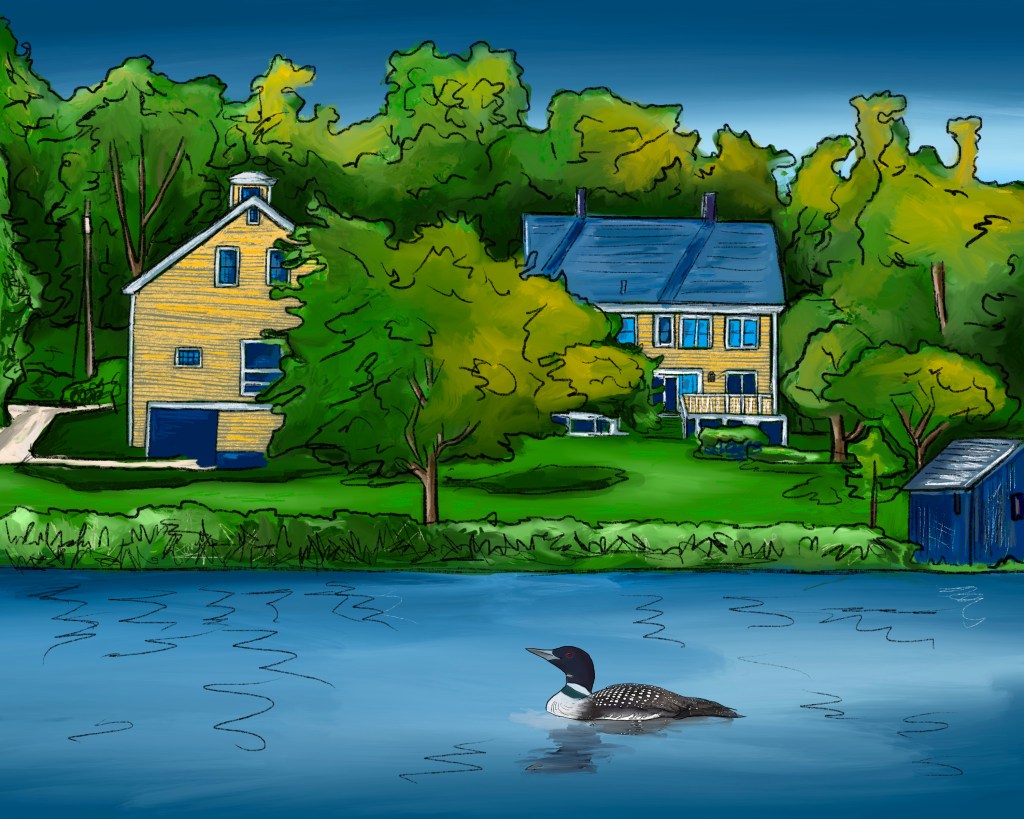
It was late in the summer, and I was sitting around a campfire at Ayers Lake Campground as the sun began to set. The day was cooling into the golden hour, my favorite time of day, when I heard the eerie wail of the Loon echo across the lake. The sound sent a thrill through me, and in that moment, I knew I wanted to capture the experience in my debut children’s book, The Loon of Ayers Lake.
I knew that I wanted my story to be a bedtime story and I wanted to feature the special scenery that makes Ayers Lake unique. So my next step was to set a goal for my Loon.
Before I began writing the story, I spent time researching loons to learn more about their unique calls and behavior. According to the New Hampshire Loon Preservation Committee, “The wail is most commonly used for long-distance communication between mated pairs of loons.” I also learned about two other calls featured in my book: the hoot and the yodel.
As I continued my research, I discovered that loons primarily eat fish, but they also feed on crayfish, frogs, leeches, and snails. For my story, I chose to have my loon catch a fish. I was also fascinated to learn that loons sleep on the water, often tucking their necks against their backs and resting for short periods at a time.
After completing my research, I determined my loon’s main goal: to call for her mate.
Would he answer her call?
Once I had my setting, character, and story goal in place, I began drafting the manuscript. Since this was my first children’s book, my process was a bit unconventional because I had already completed about half of the illustrations before the story itself was fully written.
After completing my rough draft, I entered the revision stage, polishing both the story and illustrations to bring my vision to life. I also spent countless hours researching self-publishing, learning everything from book formatting to the publication process. Each answer seemed to lead to another question, and each question led me deeper into the creative process. Before long, what started as a single moment of inspiration had grown into a finished book.
This experience taught me that inspiration can come from the simplest moments in life. What began as a peaceful evening by a campfire became the spark for my first children’s book. It opened my eyes to see the world differently and reminded me to slow down, pay attention, and appreciate the small moments that often become the most meaningful stories.


Leave a comment